(0 reviews)


Price:
$0.00
ATAMAN

Quantity:
(99 available)

Total Price:
Share:
Sold by
ATAMAN INDUSTRIAL LIMITED
香港湾仔轩尼诗道250号卓能广场15楼087室。
(0 customer reviews)


=== The following information is translated by computer. Please contact the publisher.= = =R1800—SHyper dispersant

R1800—SUltra-dispersant is a special type of polymer-based multi-functional wetting coating dispersant. It is produced under high temperature and high pressure, with a precise ratio of coating agent to dispersant. Its molecular structure can be divided into two parts: one part is the anchoring group, and the other part is the solvation chain. Its primary function is to form a protective coating on the surface of pigments and various powders. When the pigments and powders are adsorbed by theUltra-dispersant, it helps to maintain a certain thickness of the protective layer. Hyperdispersants are closely spaced, making it difficult for pigments and powders to form compact aggregates or flocculants due to the space barrier created by the protective layer (envelope). This allows the pigments and powders to disperse easily and maintain good dispersion stability in the medium. Its dispersing effect is far superior to others.BykBYK-W 996

R1800—SThere are two different ways of action of hyperdispersant, that is, in the process of treating the surface of pigments and powders, and in the process of dispersing pigments and powders.

In the process of surface treatment of pigments and powders, the action mechanism is: in the synthesis of organic or inorganic pigments and powders, once the particles of pigments and powders are formed (primary particles), they are specially designed.R1800—S超分散剂能够迅速吸附在颜料和粉末的表面,形成一层保护膜,包围这些颜料和粉末,并填充其晶格缺陷。这一过程有助于净化颜料和粉末表面那些容易聚集的活性点,从而有效防止进一步的聚集,即使晶格缺陷被填充了。在这个过程中,颜料和粉末颗粒会发生凝结。过滤,Compacting, and drying.R1800—SThe isolation effect of Hyperdispersant and the coagulation state of pigments and powders are also very loose (the contact between particles is mainly point and edge). The obtained pigments and powders are particularly easy to disperse in the subsequent application process.

The mechanism of action in the dispersing process of pigments and powders is as follows:R1800—SThe anchoring group of Hyperdispersant is adsorbed on the surface of pigments and powders, while the solvation chain can be dissolved in the dispersing medium rapidly and has good compatibility with the dispersing medium.R1800—SHyperdispersants can significantly reduce the interfacial tension between the pigment and powder particles and the dispersing medium, allowing the pigment and powder to be quickly wetted by the medium during the dispersion process. At the same time, due to the spatial barrier created by the protective layer, when the pigments and powders that have been adsorbed with the surface treatment agent are close to each other, it becomes difficult for them to further converge, thereby promoting thePigments and powders are dispersed easily and have good dispersion stability in the medium.

R1800—SEffect of Hyperdispersant in Usage

R1800—SThe most significant feature of hyperdispersants is their ability to reduce the interaction between pigments and powder particles in the dispersion medium, thereby enhancing the wettability and dispersion stability of pigments and powders in the dispersion medium. They not only provide a unique new method for the preparation of dispersion systems but also offer significant technical and economic advantages. The advantages are as follows:

Application in Masterbatch, Paint, and Plastic ProcessingR1800—SType D dispersant has the following advantages.

1(Reducing Pigment Cost)It can improve the dyeing strength of organic pigments.25%At the same time, the covering power of inorganic pigments has been improved. Even with a reduced amount of pigments, the effect remains good.10% to 20%And it will not weaken the coloring effect, thereby achieving the purpose of saving raw material costs.

2Improving Production EfficiencyWhile the traditional formula increases the screw speed, the production efficiency is improved, but the dispersion effect of the color is often reduced, and the traditional formula is used.R1800—SAfter the hyperdispersant, the output per unit time can be increased, and the dispersion effect will not be reduced, sometimes even greatly improved.

3Enhancing product qualityEliminate spot and middot, stain and shrinkage, improve surface condition, improve product smoothness, eliminate surface defects, improve impact strength, improve brightness and glossiness.

4(1) Reducing Processing CostGood product quality and stability, with a low rate of furnace downtime, resulting in less waste and saving production costs.

5Improving Processing ConditionsReduction of pigments and powders, as well as the degree of "crowding" and pigment dust during pre-mixing. Reduce waste of pigments and powders. Save on raw material costs.

6( ) Having inertiaIt does not interact with other additives. Proper use will not affect the original properties of the resin (melting index)<<` ` >>`Viscosity and Melting Point/Softening point and stress/Stress and hardness/Softness, light resistance, impact resistance, itching resistance, aging resistance, low temperature flexibility – all of these properties have their side effects.

72It can improve the insulation performance.

R1800—SHyperdispersant Dosage

Determine the amount to be added based on the oil absorption value of different powders and the particle size. Please refer to the table below for the addition:

Product Name

Mesh number

Dosage

Mesh number

Dosage

Mesh number

Dosage

Mesh number

Dosage

Calcium Carbonate

800

0.2%

1250

0.3%

1500

0.35%

3000

0.5%

Talc

800

32.0%

1250

0.38%

1500

0.47%

3000

1%

kaolin

800

0.3%

1250

0.35%

1500

0.45%

3000

0.8%

Pigment

Such as: carbon black, titanium dioxide, group blue, chrome yellow, and so on, regarding the amount of additives involved.0.3-1.2%Adjust according to the actual formula.

R1800—SMain Functions of Hyperdispersants

R1800—SThe main functions include dispersion wrapping, lubrication demoulding, toughening, and brightening. It can be used as a smooth opener, can replace maleic anhydride grafting, can adjust the product flow rate, and can improve the product's impact strength and tensile strength, among other things.

R1800—SIdentification methods

Identification of physical properties

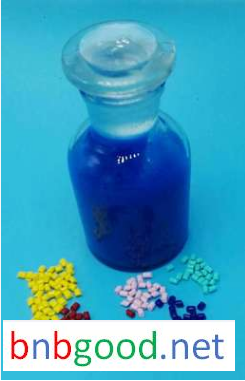
  1. R1800—SThe Hyperdispersant is a blue paste liquid.
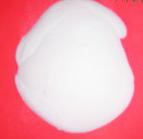
  2. Take a small amountR1800—SThe superdispersant is added to clear water.R1800—SDispersants will quickly dissolve in water and produce white flakes and a small amount of foam. (Principle: Dispersants can disperse immediately when they meet water, so they can be compatible with water very quickly; if used in powder form, they can quickly disperse and wet. The white flakes are the coating agent, which serves the function of powder pigment coating. The foam is caused by the rapid molecular motion of the dispersants in water, as demonstrated in the powder form.)R1800—SIt can disperse quickly.
  3. This is the only blue paste dispersant on the market at present, and the only product that synthesizes dispersant and coating agent on the market at present. (Benefits of Blue Phase.)1.Used in white products can play a whitening and better visual sense.2.Used in black products can play a blackening effect and increase brightness.Three.It can be used in red products to enhance the red color.4.Used in yellow products can play a role in fixing the color.)
  4. R1800—SHyperdispersant is the only oil dispersant that can dissolve in water.

Two.Disabled Items

  1. R1800—SHyperdispersants are prohibited from being used in cold-treated powders. (This means that the product cannot be used without warming it up, as it cannot be fully utilized.)R1800—SThe dispersion coating effect of Hyperdispersant
  2. R1800—SHyperdispersants are prohibited from being used in waterborne coatings and water-based inks.

R1800—SExamples of Usage of Hyperdispersant in Masterbatch

I.Calcium carbonate or talc powder filler for blow moulding. Some companies produce calcium carbonate or talc powder blow-moulding grade fillers. When used in blow-moulding, these fillers may appear as small granular pits. Such phenomena are caused by three factors.1.Calcium carbonate source contains high purity silicon dioxide. Silicon dioxide cannot be refined when grinding, so the blower mesh will be blocked with lumps of non-melting garbage, resulting in the same product appearing dull and ineffective.2.This phenomenon may also be caused by insufficient purity of calcium carbonate (too low number of particles).Three.Because the powders are too fine, the finer the powders are, the easier they are to agglomerate together. If there is no good dispersant to disperse the powders, the same problem will arise.

一些公司注意到,我购买的活性碳酸钙也会表现出这种现象。实际上,其机制相当简单。通常,粉末加工工厂使用的活性处理方法是用硬脂酸或聚乙烯蜡来处理粉末。在这个过程中,粉末被包裹起来,而不会发生分散。(这是因为硬脂酸和聚乙烯蜡根本不具有分散性;所谓的分散是指将粉末包裹起来)Powder to prevent it from agglomerating. This phenomenon is observed by some manufacturers who add additives in order to address cost issues. However, they cannot achieve the purpose of encapsulation. If the time for accumulation is too long, the powder will re-agglomerate. As a result, there will be a netting numbness phenomenon.

If usedR1800—SWe can completely solve the third problem of poor dispersion of packages. becauseR1800—SHyperdispersant itself is synthesized by Hyperdispersant and coating agent under high temperature and pressure. Its product is a blue paste, non-toxic and tasteless, and can be used as food contact grade. Its functional principle is that80Temperature conditions above degrees CelsiusR1800—SIt can quickly turn into powder to achieve dispersion and coating effect. After cooling, the coating agent will solidify. Therefore, the coated powders will no longer coagulate together, which fundamentally solves the problem.

2. Why do color spots appear during the coating process? The main reasons are poor dispersion of the masterbatch pigments and clumping. As a result, the color of the coated film is uneven, and black spots may even appear due to dispersion issues. It is recommended to purchase high-quality dispersants when producing masterbatches.R1800—SSuper dispersant; Proper control of processing temperature, and cleaning of the screw and machine head to solve this problem.

3. Why do coated films produce patterned patches of different colors?How to solve it? The above phenomena are mainly caused by poor dispersion of masterbatches or fading of pigments in masterbatches due to poor temperature and heat resistance. It is also possible that the melt index of masterbatches differs greatly from that of coated resins, resulting in inconsistency in fluidity. Solution: Choose a good dispersant when making masterbatch (e.g.R1800—S(超分散剂) 选择能够抵抗高温的颜料,并为色母粒选择一种熔指与涂层树脂相近的载体树脂。然后,适当调节涂层机各部分的温度,以确保两种树脂的粘度相近。

4. Why do certain color masterbatches affect the heat sealing performance of films? When films without color masterbatches have normal heat sealing performance, this is usually related to the additives in the color masterbatches. Currently, some manufacturers of low molecular weight polyethylene waxes use the method of adding paraffin to reduce costs and win customers.10% - 40%Unequal. The low molecular weight, low melting point, and decomposition temperature of paraffin wax are much lower than those of low molecular weight polyethylene wax. This results in the decomposition and sublimation of paraffin wax during processing, migration to the surface of the film, and frosting phenomena, which affect the sealing quality. Additionally, due to the thermal decomposition of paraffins at different processing temperatures, small molecules will migrate to the surface,Affecting the heat resistance of the material. Sealing performance. The main role of low molecular weight polyethylene wax in color masterbatch is dispersive lubrication, if used.R1800—SSuper dispersants can significantly reduce the amount of low molecular weight polyethylene used, thereby achieving the desired results.

5. What causes filament breakage in flat wire production?High Density PolyethyleneorPolypropyleneThe resin melt is extruded into a flat film, which is then cut into thin filaments of a certain width using a tool fixture with a specific gap (referred to as embryonic filaments). The thin filaments obtained through unidirectional stretching are known as film-breaking fibers worldwide, while in China, they are commonly referred to as flat filaments. Flat filaments can be woven into knitted bags, and colored strips and waterproof materials can be knitted on flat looms.

During the production process of flat filaments, breakage is a common issue that occurs during the drawing process. Breakage results in a large amount of waste filament, significantly increasing raw material consumption. In severe cases, it can cause downtime. The main reasons for this include too high melt index of the resin, insufficient tensile strength, too high stretching ratio, too low cooling water temperature, rapid crystallization, and impurities in the raw materials. Poor dispersionOf the masterbatch, or too large pigment particles in the masterbatch, as well as poor compatibility between the carrier and the resin, can lead to an uneven surface of the film. Excessive water in the extrusion cooling water can result in low stretching temperature, often causing breakage outside the oven. If this phenomenon occurs during the production of masterbatches, it is necessary to choose a good dispersant.R1800—SSuper dispersants can completely solve this problem.

6. What causes the surface of color masterbatches to not be as shiny as it should be? The smoothness of the surface of a color masterbatch can be used as an initial indicator of the quality of the masterbatch. Some color masterbatches suffer from uneven mixing and dispersion due to reasons such as raw materials, formulations, and processing techniques, resulting in a rough surface. In severe cases, there may be significant color spots on the surface of the color masterbatch due to poordispersion.

It was found that the surface of the masterbatch is not smooth during the production process. The first step is to check whether the extrusion temperature is appropriate. An excessively high or low extrusion temperature or die temperature can cause the surface to become rough. In this case, the extrusion temperature needs to be adjusted. If repeated adjustments are ineffective, it may be due to the following reasons.

  1. The dispersibility of the pigment is crucial. If the pigment molecules are too dense, they will not disperse effectively in the plastic, leading to a rough surface.
  2. Whether the quality of the dispersant (low molecular weight polyethylene wax) is qualified and the dosage is appropriate. If some low molecular weight polyethylene waxes are mixed with paraffin, or if they are high density low molecular weight polyethylene waxes, it will affect the dispersibility of the pigment.
  3. The lubrication treatment of the pigments is not appropriate. No matter what methods are used, it is impossible to obtain a color masterbatch product with good dispersibility and a smooth surface.

Therefore, it is hoped that the use ofR1800—SUltra-dispersant, fundamentally solving such problems.

VII. ProductionPVCPlastic stabilizers (lead salt composite stabilizers, lead-barium composite temperature agents, barium-zinc composite stabilizers, etc.) are added.0.5% R1800—SSuper dispersants can make the composite stabilizer more compatible withPVCCompatible and more evenly dispersedPVCIt serves to lubricate and demold both inside and out, significantly improving the thermal stability of the product.

VIII. Add during the processing of calcined kaolinR1800—SThe super dispersant can improve the dispersion effect of kaolin, and also enhance the insulation properties of kaolin when used in cable materials.


Contact the supplier or send an email to admin@b2bgood.com for purchase assistance.
There have been no reviews for this product yet.

Product Queries (0)

Login or Registerto submit your questions to seller

Other Questions

No none asked to seller yet